CIC Corporation.
Introduction to the Company-wide AI Transformation Project (MIR:AI) and CIC × Shimane University Research & Development Projects
CIC has launched the company-wide AI Transformation Project (MIR:AI), combining task support by specialized AI agents with quality gates and human review and decision-making to realize a development process in which AI and people work together.
This exhibition introduces our AI agent-powered development process support and testing process support.
Through industry-academia collaboration with Shimane University, CIC is conducting research and development on assistive technologies for people with disabilities using smart devices, as well as infrastructure monitoring technologies using sensing technologies.
This exhibition also introduces our ongoing research and development projects.
By strengthening collaboration across a wide range of fields, we aim to expand opportunities for providing services to our customers and advancing research and development, while creating new business opportunities.
Contact us(MIR:AI):mirai@cichdgroup.com
Products & Services
Company-wide AI Transformation Project (MIR:AI)
1) AI-Powered Development Process Support
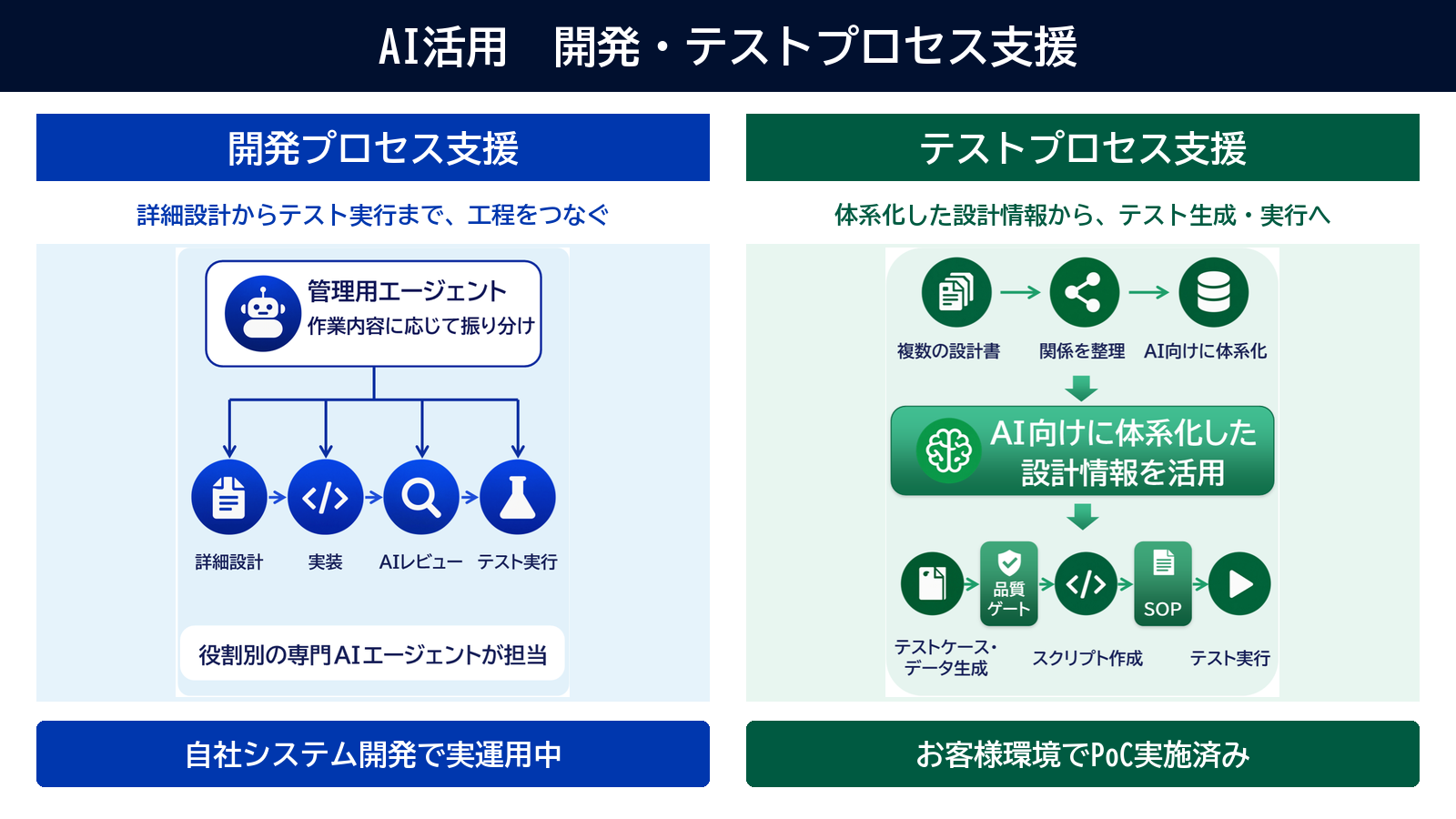
AI agents support the development process from detailed design and implementation through code review and testing. A coordinating agent assigns tasks to specialized agents based on each request, and the agents work in accordance with common standards and project-specific rules.
AI-based reviews serve as an initial quality check, while people remain responsible for reviewing and approving deliverables and deciding whether to proceed to the next phase.
We will showcase this approach, which is already in practical use in our own system development projects.
2) AI-Powered Testing Process Support
We organize and structure information across multiple design documents into AI-ready design knowledge, which is then used to support the entire testing process, from generating test scenarios and test data to creating test scripts and executing tests.
Multiple AI agents share generation and verification tasks, with quality gates, SOPs (Standard Operating Procedures for quality assurance), and human review incorporated into the process.
We will showcase this approach through a PoC (Proof of Concept) conducted in a customer environment.
Soil Moisture Detection and Visualization of Water Leakage Information Using Wi-Fi Sensing
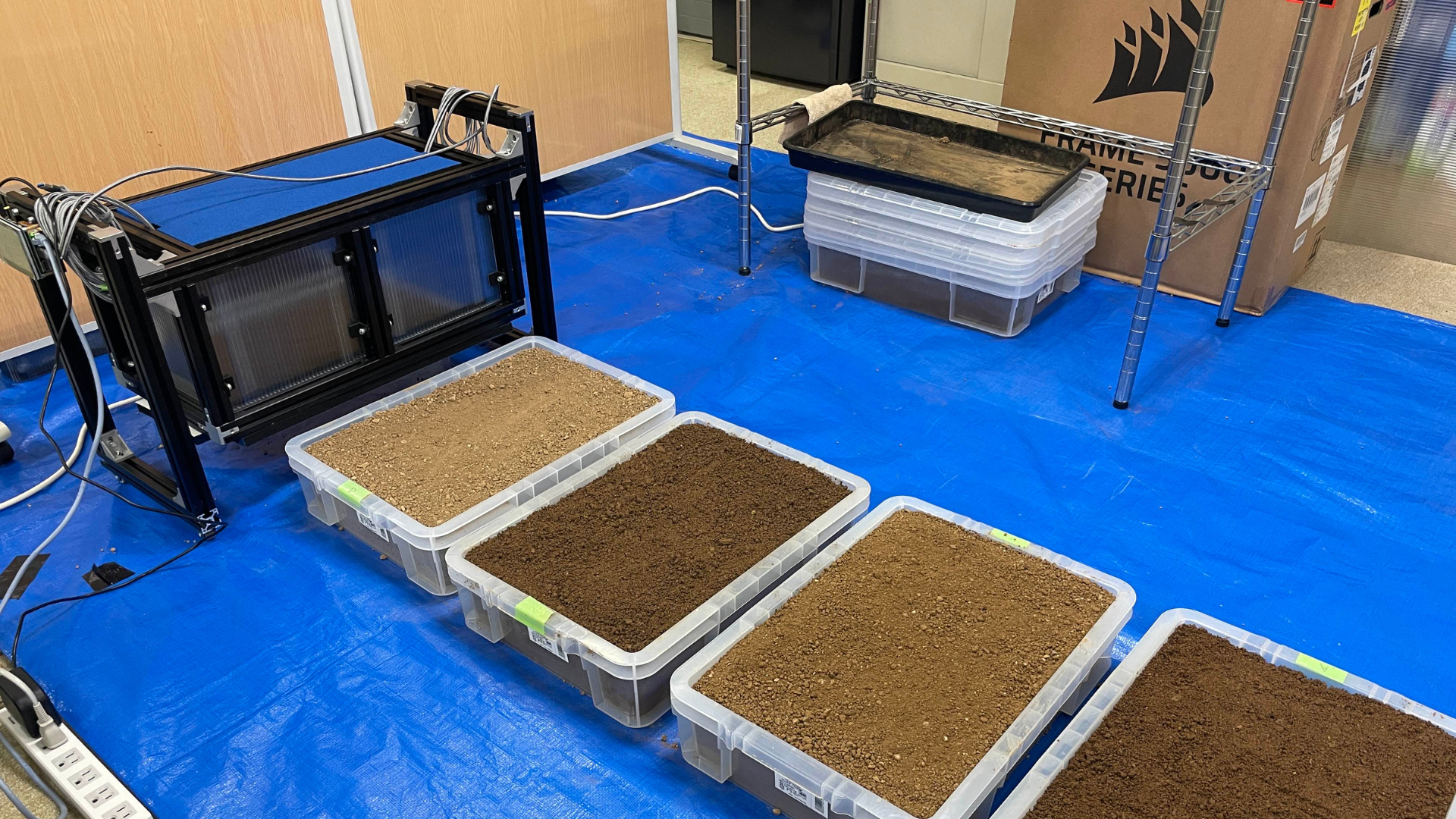
We are conducting joint research and development with the Kanzaki Laboratory at Shimane University on a technology that uses reflected Wi-Fi signals to detect soil moisture conditions without physical contact. By analyzing the propagation characteristics of radio waves, we aim to identify changes in moisture levels and help locate areas where water leakage may be occurring.
At this exhibition, we will demonstrate a working prototype in which a scanning carriage moves along a rail, scans the soil using Wi-Fi signals, and displays whether the soil is dry or wet.
We will also introduce our "Water Leakage Visualization System," which is currently under development. This system visualizes soil moisture conditions on a map and provides features such as overlaying water distribution pipe maps and reviewing historical moisture conditions. Through these features, we aim to help users understand changes in soil moisture and how moisture spreads over time, supporting the identification of potential water leakage locations and the selection of areas for further investigation.
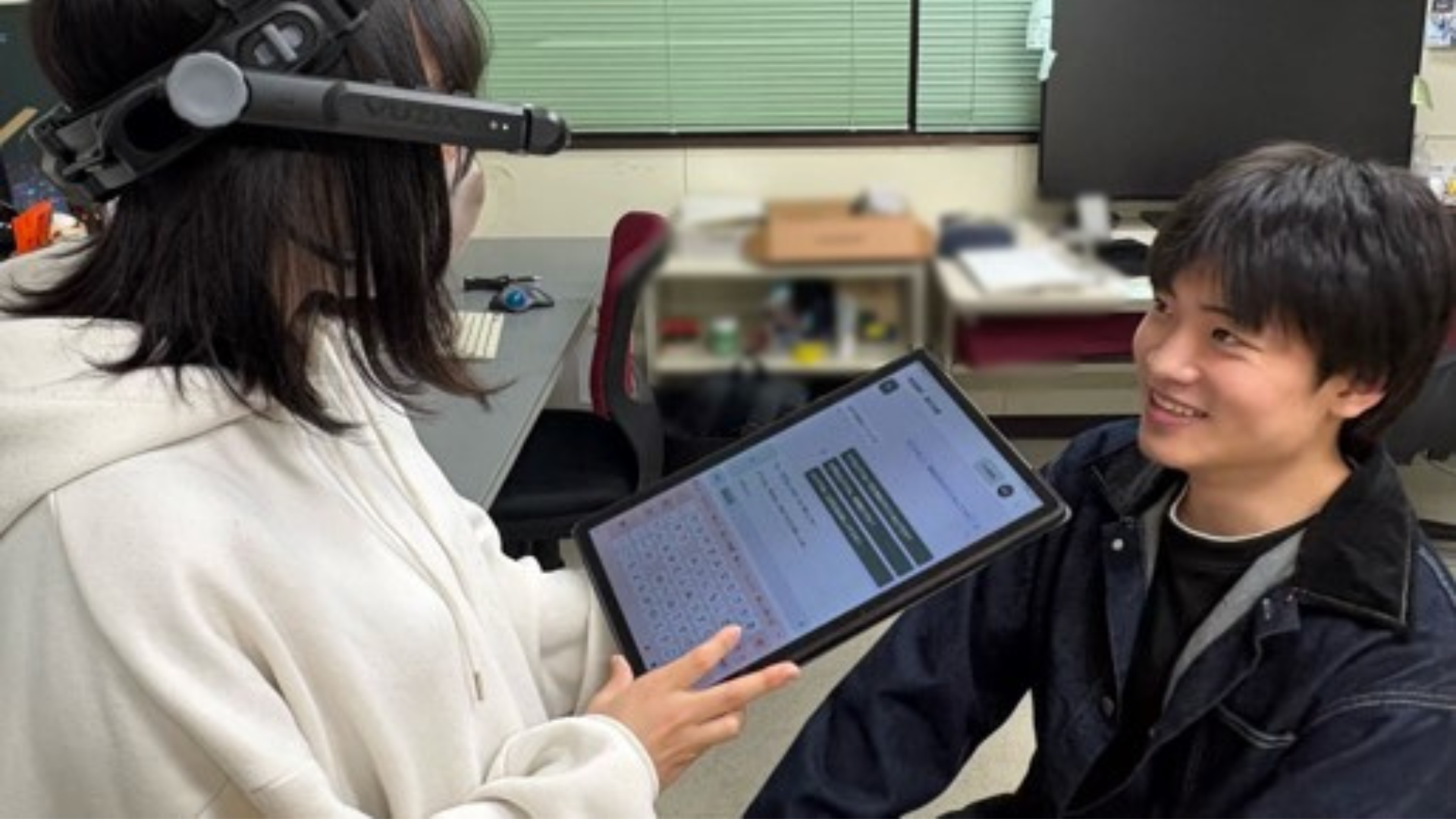
Supporting Authentic, Personalized Communication with AI and Smart Glasses
In collaboration with the Hirotomi Laboratory at Shimane University, we are conducting research on "Smart Assistive Technology," which uses ICT to support communication and daily living for people with disabilities.
As part of this research, we are developing an application that combines AI and smart glasses to help people who have difficulty speaking express their thoughts and intentions. The smart glasses recognize conversation partners and display relevant information, while AI suggests possible responses based on the flow and context of the conversation.
Furthermore, by incorporating the user's personality traits, speaking style, relationships with others, and conversation history, the application aims to support natural communication that reflects each individual's thoughts and unique personality, rather than providing generic responses.
Our goal is to reduce the effort required to express oneself and help create a society where everyone can participate confidently in social interactions.