
Liberal Logic Inc.
Making AI-created deliverables verifiable by people: EAUNIT, Argumentation Support for the AI Era
In the AI era, AI has taken over much of the work of understanding a subject and implementing it, work that people used to do. As a result, there are more situations where the traditional approach of deepening one’s understanding while writing is no longer available. Even so, people remain responsible for the deliverables, and human understanding remains essential.
To understand deliverables you did not write yourself, you need to know what each one is for and what verifies it. EAUNIT records these relationships in the Enterprise Architect model as connections between deliverables such as requirements, design, implementation, and tests. By following the connections from needs to test results, the large question of whether the system meets its requirements breaks down into questions small enough for a person to judge. Even for deliverables created by AI, people can check on the model, one step at a time, how far the argument holds.
Products & Services

01 When Humans Wrote the Code
Before 2025, people wrote both the code and the unit tests. You couldn't write either one without understanding what you were working on. People learned as they wrote, and their understanding grew deeper. That's why they could explain, in their own words, why the code was correct.
02 When AI Writes the Code
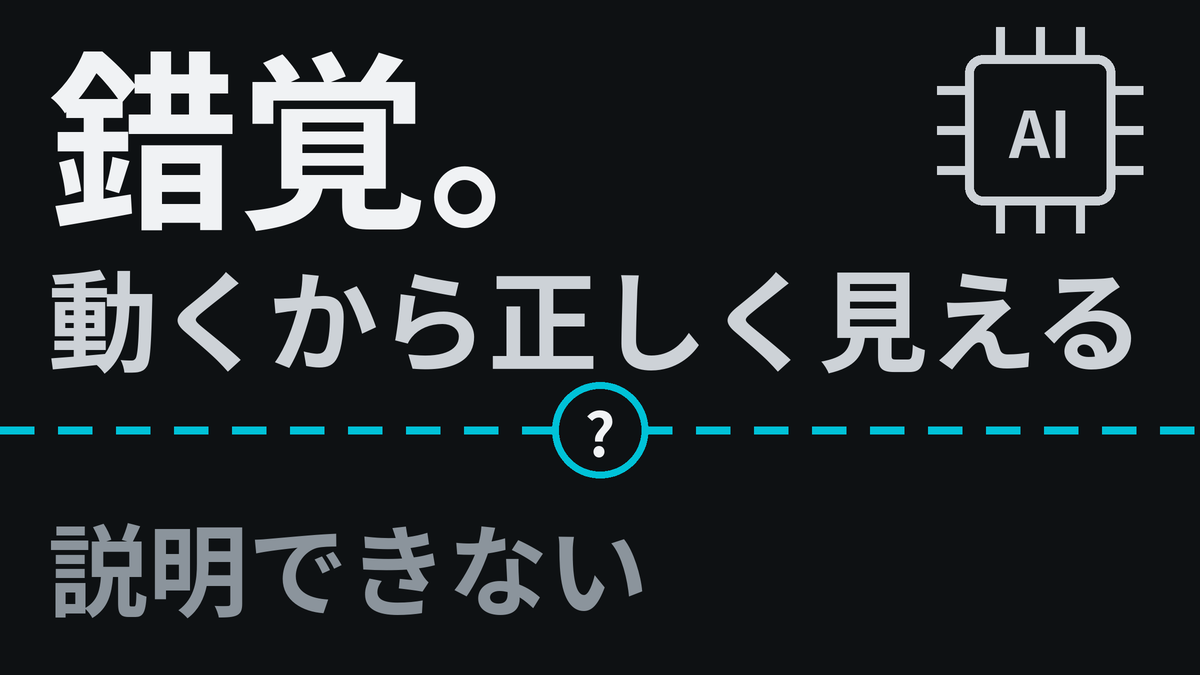
Today, AI writes everything from requirements to design, implementation, and unit tests, and delivers something that works. Even if it passes its tests, those may be tests the AI wrote just so they would pass. People who didn't write it can't explain why it's correct.
03 EAUNIT | Argumentation Support for the AI Era
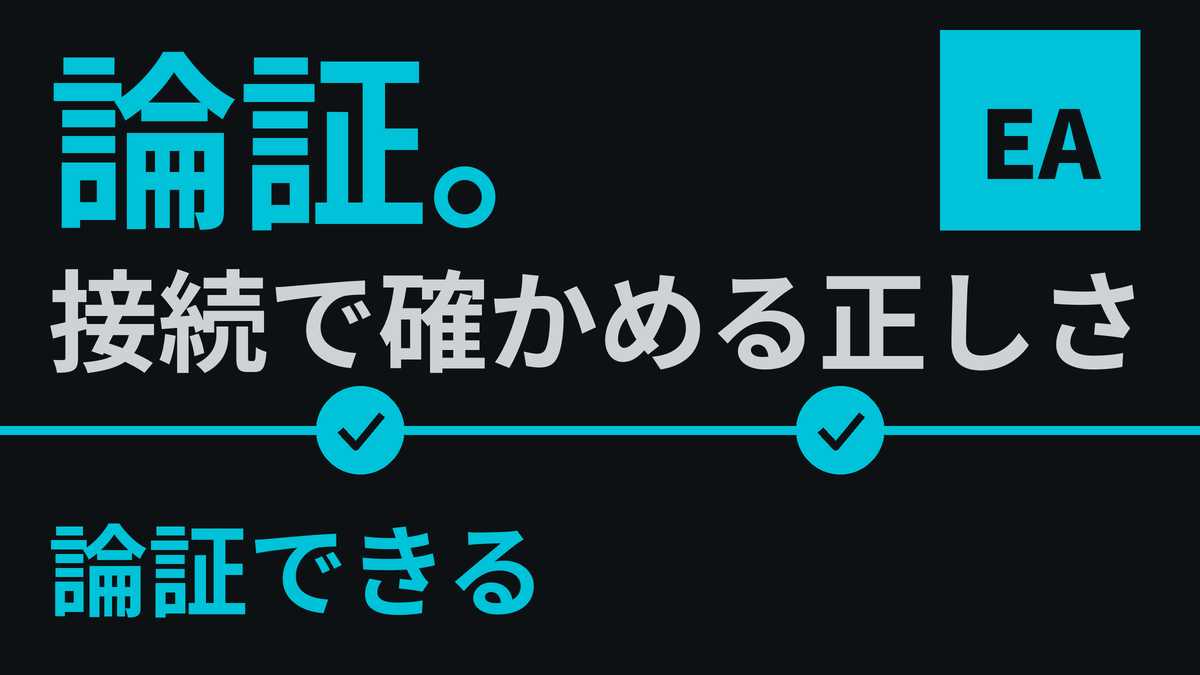
Requirements to test results, traced in one model. You can understand it by verifying it. EAUNIT connects every work product, from stakeholder needs to unit test results, within an Enterprise Architect model. By checking those connections one by one, people deepen their understanding and can argue, with evidence, that the system meets its needs.
Related Videos
Deriving Requirements from Needs, and Validating Them
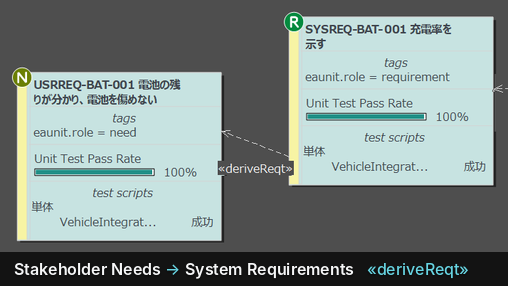
The model maintains derivation relationships from stakeholder needs to system requirements («deriveReqt», «refine»). Unit test results are rolled up to the stakeholder needs along requirement containment and derivation relationships, showing the verification status of each need. Any need with requirements below it that are not yet verified is marked as “partially unverified,” so you can see at a glance which needs have verification gaps. This verification status does not substitute for validating the needs; it serves as input when confirming them with stakeholders and through analysis.
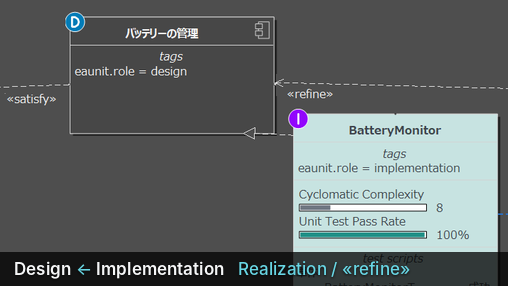
Realizing Design Elements, and Their Structural Quality
Relationships are used as follows. Realization links an implementation class to the design element it realizes, and «allocate» assigns functions or behaviors to structural elements; in models that do not use SysML, «trace» is used instead. Specifications defined during preliminary design are treated as requirement elements, which detailed design elements satisfy via «satisfy». Model elements that express a specification more precisely, such as interface definitions or behavior models, are linked to it via «refine». All of these relationships point from the more concrete element to the more abstract one. Unit test results are also aggregated per design element, and each class’s dependencies and per-method cyclomatic complexity are displayed alongside the test status. As a result, human-written code and AI-generated code can be checked against the same criteria.
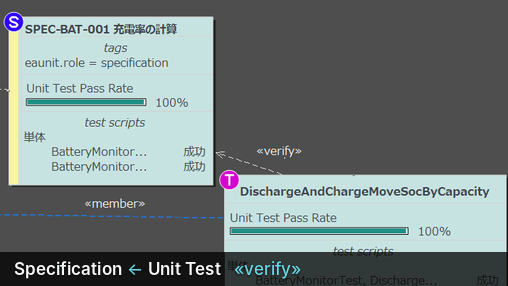
Unit Test Results as Verification Evidence
Unit tests are linked to requirements from verification declarations written in the code, via «verify» (or «trace» in models that do not use SysML). Results are rolled up to higher-level requirements along requirement containment and derivation relationships. A requirement is marked “verified” when at least one test verifies it directly and every test that traces to it, directly or through those relationships, has passed. This “verified” status covers only what unit tests can verify. For properties that emerge only at the system level, such as performance or interactions between components, evidence from integration testing, system testing, analysis, and inspection is linked to requirements through the same mechanism and included in the roll-up. Rather than relying on pass rates alone, the model shows how many requirements have no tests and how many are partially unverified. The requirements verification matrix lists, for each requirement, which verification was performed, when, by which method, and from which result file.